Joint-space motion control#
sdu_controllers implements a joint-space motion controller with inverse dynamics control as described on page 330 in Siciliano et al. [SSVO09]. By using this controller you can make a robot follow an arbitrary joint-space trajectory that is defined within the limits of the robots. This page contains two examples, in the first example we use the Universal Robots UR5e 6 DOF robot manipulator and in the second example the more advanced 7 DOF breeding blanket handling robot.

The dynamic model of an n-joint robot manipulator given by the Euler-Lagrange equation can be written as:
where \(B(q)\) is the inertia tensor, \(C(q, \dot{q})\) is a matrix containing Coriolis and centrifugal terms, \(g(q)\) is the gravity vector, and \(u\) is the actuator torque. By taking the control \(u\) as a function of the manipulator state in the form:
then the system can be described as
where \(y\) is our auxiliary input signal.
We can then choose to have PD-control acting on the desired joint positions \(q_{d}\) and joint velocities \(\dot{q}_{d}\) like the following:
here the acceleration is used as feed-forward \(u_{ff} = \ddot{q}\).
Note
You can also choose the gravity vector as feed-forward so that \(u_{ff} = g(q)\), which will make the controller compensate the gravity forces.
UR5e robot joint-space control#
With the trajectory generated we can now try to run the joint motion control. You can choose to make your own
example with a .cpp or .py file or feel free to simply use the one available under
examples/ur_examples/joint_motion_controller.cpp
or
examples/ur_examples/python/joint_motion_controller.py.
The code for joint-space motion control is listed here in C++ and Python:
#include <Eigen/Dense>
#include <fstream>
#include <iostream>
#include <sdu_controllers/controllers/pd_controller.hpp>
#include <sdu_controllers/math/inverse_dynamics_joint_space.hpp>
#include <sdu_controllers/models/ur_robot.hpp>
#include <sdu_controllers/models/ur_robot_model.hpp>
#include <sdu_controllers/utils/utility.hpp>

// Initialize robot model and parameters
auto robot_model = std::make_shared<models::URRobotModel>(URRobot::RobotType::UR5e);
double Kp_val = 1000.0; // Proportional gain
double Kd_val = 2 * sqrt(Kp_value); // Derivative gain
double N_val = 1; // Feed-forward gain
uint16_t ROBOT_DOF = robot_model->get_dof();
VectorXd Kp_vec = VectorXd::Ones(ROBOT_DOF) * Kp_val;
VectorXd Kd_vec = VectorXd::Ones(ROBOT_DOF) * Kd_val;
VectorXd N_vec = VectorXd::Ones(ROBOT_DOF) * N_val;

controllers::PDController pd_controller(Kp_vec.asDiagonal(), Kd_vec.asDiagonal(), N_vec.asDiagonal());
math::InverseDynamicsJointSpace inv_dyn_jnt_space(robot_model);

VectorXd q_d(ROBOT_DOF);
VectorXd dq_d(ROBOT_DOF);
VectorXd ddq_d(ROBOT_DOF);

VectorXd q(ROBOT_DOF);
VectorXd dq(ROBOT_DOF);
q << 0.0, -1.5707, -1.5707, -1.5707, 1.5707, 0.0;
dq << 0.0, 0.0, 0.0, 0.0, 0.0, 0.0;

// Read input trajectory from file
std::vector<std::vector<double>> input_trajectory = get_trajectory_from_file("../../examples/data/joint_trajectory_safe.csv");

// Control loop
for (const std::vector<double>& trajectory_point : input_trajectory)
{
  // Desired
  for (Index i = 0; i < q_d.size(); i++)
  {
    q_d[i] = trajectory_point[i];
    dq_d[i] = trajectory_point[i+ROBOT_DOF];
    ddq_d[i] = trajectory_point[i+(2*ROBOT_DOF)];
  }

  VectorXd q_meas = q;
  VectorXd dq_meas = dq;

  // Controller
  VectorXd u_ff = ddq_d; // acceleration as feedforward.
  // VectorXd u_ff = robot_model->get_gravity(q_meas); // feedforward with gravity compensation.
  pd_controller.step(q_d, dq_d, u_ff, q_meas, dq_meas);
  VectorXd y = pd_controller.get_output();
  VectorXd tau = inv_dyn_jnt_space.inverse_dynamics(y, q_meas, dq_meas);
  std::cout << "tau: " << tau << std::endl;
}
import numpy as np
from numpy import genfromtxt
import sdu_controllers

joint_traj = genfromtxt('examples/data/joint_trajectory_safe.csv', delimiter=',')
Kp_val = 100.0  # Proportional gain
Kd_val = 2 * np.sqrt(Kp_val) # Derivative gain
N_val = 1 # Feed-forward gain

Kp = np.diag([Kp_val, Kp_val, Kp_val, Kp_val, Kp_val, Kp_val])
Kd = np.diag([Kd_val, Kd_val, Kd_val, Kd_val, Kd_val, Kd_val])
N = np.diag([N_val, N_val, N_val, N_val, N_val, N_val])

ur_robot = sdu_controllers.URRobotModel()
pd_controller = sdu_controllers.PDController(Kp, Kd, N)
inv_dyn_jnt_space = sdu_controllers.InverseDynamicsJointSpace(ur_robot)

q = np.array([0.0, -1.5707, -1.5707, -1.5707, 1.5707, 0.0])
dq = np.zeros(6)

for joint_q in joint_traj:
    q_d = np.array(joint_q[0:6])
    dq_d = np.array(joint_q[6:12])
    ddq_d = np.array(joint_q[12:18])

    u_ff = ddq_d
    # u_ff = ur_robot.get_gravity(q_meas); // feedforward with gravity compensation.
    pd_controller.step(q_d, dq_d, u_ff, q, dq)
    y = pd_controller.get_output()
    tau = inv_dyn_jnt_space.inverse_dynamics(y, q, dq)
    print('tau:', tau)
You have to provide gains for the PD controller using the variables Kp_val and Kd_val
and optionally a feed-forward gain using the variable N_val.
If you plot the output joint torques from the variable tau, you should get something similar
to the following figure:
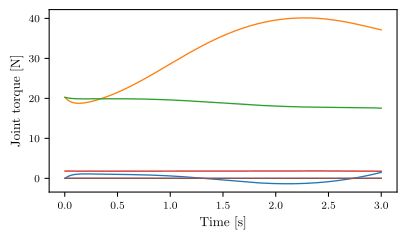
In order to check whether the output torques produces a robot movement that ressembles the input trajectory, a simulation can be performed by using forward dynamics to calculate an output trajectory based on the output torques \(u\). This output trajectory can then be compared with the input trajectory.
The forward dynamics can be calculated using Eq. (7.115), from page 293 in Siciliano et al. [SSVO09]:
this gives us the acceleration \(\ddot{q}\), which can be integrated to yield the velocity \(\dot{q}\), which can also be integrated to yield the position \(q\).
Breeding blanket handling robot joint-space control#
int main(const int argc, const char **argv) {
  return 0;
}
def main():
    return
see additional examples in the Examples section.